4.1.3 Television
The use of the TV programmes available in Austria via terrestrial transmitter systems, TV satellites or cable networks constitutes an essential factor with regard to the forming of public opinion, in particular, to the forming of public opinion in respect of the television programmes of the ORF, which account for about half of all market shares in television. Especially, the information channels of the ORF (not only the news broadcasts in the narrower sense) are regarded as very important also for the political forming of opinion.
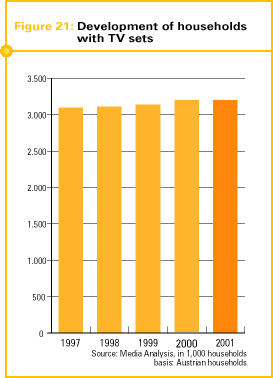
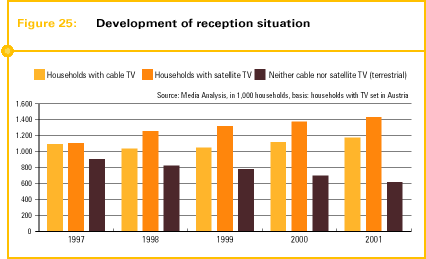
The importance of television for social and communications policies goes hand in hand with the households being equipped with TV sets. In 2001, 3.198 million households were found to be equipped with at least one, in many cases also with several TV sets. This overall figure corresponds to a degree of saturation of 97.4% of all households (Media Analysis 2001). The development axis of the past five years clearly shows that any further increase in the degree of saturation with regard to the availability of TV sets is almost impossible, as a rise of only 3.3% to 3.198 million households had been achieved since 1997 (3.096 million households equipped with TV sets).
The Austrian TV consumers receive the TV signal via three different platforms. In the 1960’s and 1970’s TV was introduced by distributing the programmes and signals exclusively via terrestrial transmitter systems; in the 1980’s, especially in Vienna but also in the provincial capitals and in smaller urban areas of Austria, the distribution of the programmes via cable TV networks was added. The essential benefit for the customer, from the providers’ point of view, was the steadily increasing number of programmes that were distributed, in addition to ORF 1 and ORF 2, as well as the fact that detached houses or housing developments could be spared the rather unattractive antennas on the roofs. In the 1990’s, it became more and more popular to receive TV programmes via so-called broadcasting satellites, especially on the outskirts or outside of the cities that, until then, had not been reached by the cable TV networks.
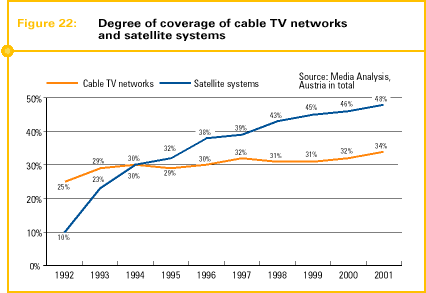
The number of Austrian TV households that received their programmes via broadcasting satellites drew even with the number of households supplied via cable networks only in 1994. 30% each of all TV households received their television signals from a broadcasting satellite or a cable network. Since 1994, the number of households with satellite supply increased to 48%, while the degree of coverage by cable TV remained almost unchanged at 34%.
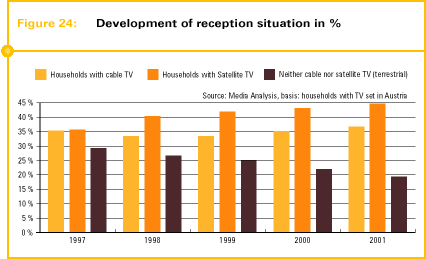
The detailed development of the five years from 1997 to 2001 makes it clear that the significant increase in households supplied via broadcasting satellites led to a substantial reduction, in particular, in the number of households that were exclusively supplied via terrestrial transmitter systems (house antennas). In percent, the households that were exclusively supplied via terrestrial transmitter systems declined from 29.3% (1997) to 19.3% (2001), while over the same period the percentage of satellite supplied households increased from 35.7% (1997) to 44.7% (2001). It has to be noted in this respect that the households supplied with broadcasting satellites, as a rule4, depend on the terrestrial transmitter systems in order to be able to receive the two ORF TV channels. The same applies to the second and third TV sets in households that are also equipped for satellite reception. 44% of all TV households have a second or several TV sets (Source: Media Analysis 2001).
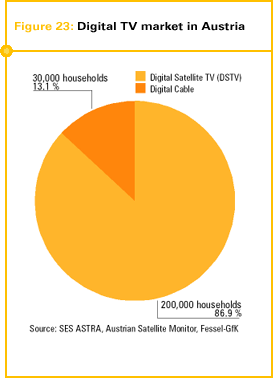
On the satellite and cable network transmission platforms, TV programmes are also transmitted digitally. According to SES ASTRA, Austrian Satellite Monitor, 230,000 households received also digital television programmes in 2001, 200,000 of which via the ASTRA broadcasting satellite and 30,000 via cable networks. The digital TV programmes that could be received were, in particular, those of "Premiere World" (pay TV) as well as those of the ORF.
The average daily TV consumption in Austria (viewing time) increased steadily, though not dramatically in recent years. Although the daily viewing time did not come close to American viewing habits by far, it corresponded to the average usage in other European countries. This increase over the past few years was due to the considerably larger number of TV programmes, on the one hand, and the increased amounts of time available for leisure time activities of the average total population (working time, degree of occupation, retirement), on the other.
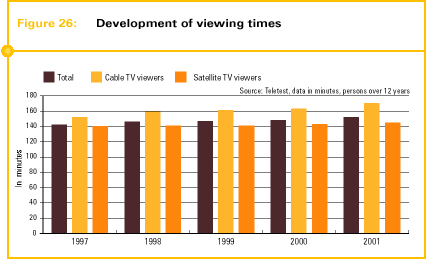
From 1997 to 2001, the average viewing time in all TV households increased
by 7%, from 142 minutes to 152 minutes a day. TV consumption in households
with a wider range of programmes due to satellite or cable TV was almost
the same; it increased by 7.6% from 145 minutes to 156 minutes a day.
Only when comparing households with cable TV and satellite TV, it can be seen that cable consumers spent significantly more time in front of the TV: customers of cable TV operators watched their programmes for an average of 170 minutes a day, while viewers of satellite TV watched "only" for 145 minutes a day.
The viewing habits of the Austrians are recorded within the framework
of the "Teletest". The "Teletest" is an electronic
type of data collection, which is regularly carried out by the Fessel-GfK
market research institute on behalf of the ORF to provide information
about viewing times and concrete usage of programmes, on the basis of
1,500 test households that were selected according to demoscopic criteria.
According to the "Teletest", 67.9% of all Austrians over 12
years of age watched at least one programme daily during the period under
review (regardless of how long the programme was watched). Since 1997,
this share increased from 66.3% of all Austrians by only 1.6%, which shows
that the television medium has a very stable daily service range.
The channels of the ORF (ORF 1 and ORF 2) reached the
highest daily service ranges among the overall population (persons over
12 years). During the period under review, ORF 2 reached clearly higher
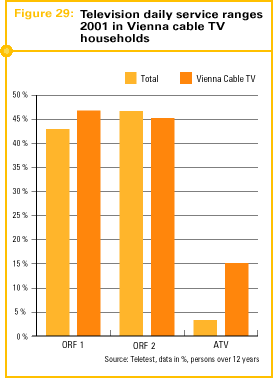
service ranges (ORF 1: 42.9%, ORF 2: 46.7%). Since another Austrian channel,
ATV, could be received only by cable TV users, it achieved a daily service
range of only 3.3%.
Comparing the TV programmes of the ORF with international TV programmes,
the daily service ranges of both programme groups were shown to be equally
high. The ORF programmes reached 60.8% of the Austrians, while the international
programmes reached 60.2%. In the cable TV households, the German TV programmes
that also offered so-called "Austria windows" were watched extremely frequently:
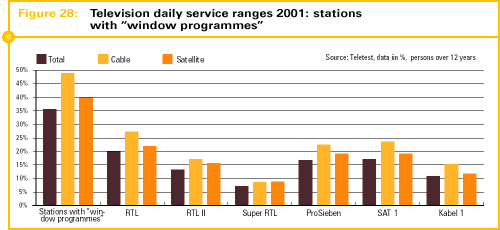
48.9% watched a "window programme" (RTL, RTL II, Super RTL, ProSieben,
Kabel 1 and SAT.1) for at least one minute a day.
With regard to the total daily service ranges, the ranking of the German TV channels that offer an "Austria window" was as follows: RTL (19.8%), SAT.1 (17.2%), ProSieben (16.8%), RTL II (13.3%), Kabel1 (10.8%), Super RTL (7.1%). For cable TV viewers, the daily service ranges were higher by a few percent each (see Fig. 28). The ranking, however, was the same for households with cable and satellite TV.
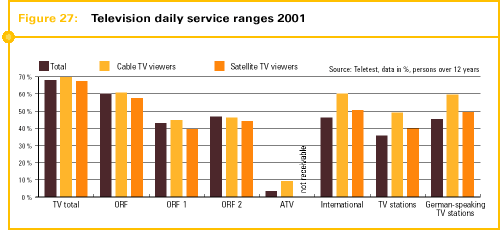
The TV habits and daily service ranges resulting from the "Teletest" showed a special characteristic with regard to ATV. With a daily service range of 15.2%, the ATV channel is watched by the cable TV users in Vienna significantly more often than by the Austrian average of cable TV users (9.3%) and by the average of all TV users (3.3%).
The higher daily service range of ATV in the Vienna cable network is probably related to the "privileged" position with regard to frequency assignment provided by the cable operator5, in addition to the image as "Viennese" channel that is being created. This example illustrates the special importance of non-discriminatory access or equal access to the communications platforms.
The market shares of the respective TV broadcasters are of particular
importance to the advertising industry. Related to all Austrians over
12 years of age, the ORF with its TV programmes had a market share of
55.5%, whereas the international stations taken together reached 43.4%.
However, in the households with cable TV the situation was quite the opposite:
the non-Austrian programmes taken together reached a market share of 53.5%,
while ORF 1 and ORF 2 had a market share of 44.4%.
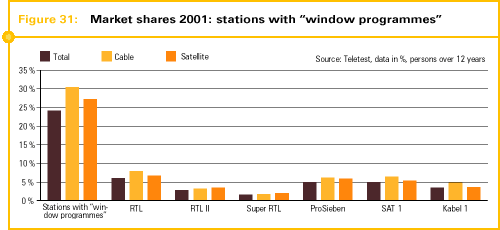
With international TV programmes, the vast majority of the market shares was attributable to the German-speaking stations. Here, once again, the providers of so-called "Austria windows" accounted for the major part. ATV reached a market share of 1.3% in the Austrian cable networks. It has to be noted that, similarly to the daily service ranges, the ATV channel in the Vienna cable network, with 2.1% of the market shares, reached a clearly higher value than in the average of all cable networks in Austria.
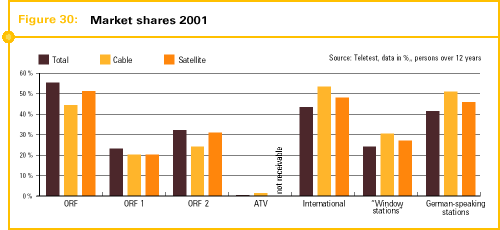
in households supplied via broadcasting satellites they reached 27.2%, while in the cable networks they reached a market share of 30.4%, which may be due to the additional advertising and programme offers. Among these programmes, RTL, SAT.1 and ProSieben had the highest market shares with figures between 7.9% and 6.2% (in the cable TV households).