|
2.3.2 Unbundling A number of options for providing their customers with telecommunications services is available to alternative network operators (ANBs). Basically, ANBs (but also ISPs) can link their customers to their network by means of their self-constructed infrastructure or offer their services as so-called carrier network operators. With this option, they can offer services on the market via Carrier Pre-Selection or as Call-by-Call services. Moreover, it is possible to lease segments in the access network of Telekom Austria in order to reach customers in this way. The lease of a subscriber access line (TASL) is called TASL unbundling ("local loop"). As a result of TASL unbundling, alternative network operators (and - in the meantime - also other "unbundling partners", such as ISPs or operators of leased lines) no longer have to resort to constructing their own infrastructure, but can use the (copper) access network of Telekom Austria to directly link up their end users. |
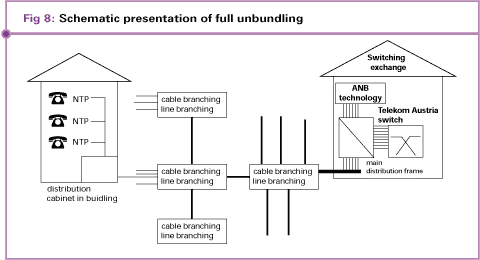
A distinction is made between full unbundling and joint access to TASL ("shared use") when speaking of unbundling. In addition, an access to sub-segments of the TASL ("sub-loop unbundling") is also possible. For a full unbundling of the local loop (TASL), the pair of copper wires at the main distribution frame is no longer connected to the local connection switching processor of Telekom Austria but directly (connected electrically) to the unbundling partner. |
|
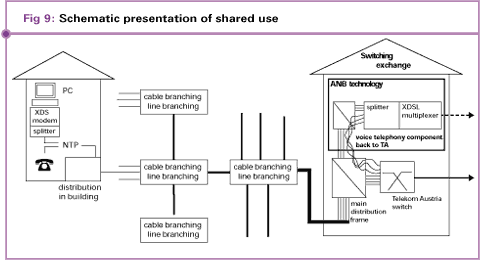
When implementing unbundling in the form of "shared use", only a high bit-rate service (e.g. ADSL) is provided by the unbundling partner, while voice telephony remains with the previous network operator (Telekom Austria). Telephone and data traffic are separated by a frequency filter ("splitter"), upstream of the exchange of the incumbent. |
The infrastructure required for separating voice (in the lower frequency range) from the data flow (higher frequency range) can either be operated by the incumbent or the unbundling partner. In Austria, the unbundling partner will use his own equipment, i.e. a modem and a splitter, with the end user, as well as a splitter and a DSL access multiplexer ("DSLAM") at the network, for feeding back the voice telephony part to Telekom Austria. |
|
Several services may be provided via one and the same TASL (local loop). These services may be either normal voice telephony services (POTS), ISDN services but also high bit-rate services, such as rapid Internet access by means of xDSL. While the double copper wire (CuDA) remains the same, which means that the same costs continue to accrue for the physical medium (= double copper wire), the end-user tariff and the possible profits generated with the different services will vary considerably. Basically, end users can be connected to a telecommunications network either via an operator's own infrastructure or by using other, already existing infrastructure. While it is generally desirable for alternative network operators to have their own access network (more flexibility and autonomy), re-cabling all of Austria is very expensive, especially the last stretch ("last mile") to the end user, and does not make sense economically. A direct connection of (highly profitable) business customers via their own connection network, still requiring expansion, may be useful in individual cases or for strategic considerations. |
There are mainly two main alternatives for linking up the remaining major part of end users to the incumbent:
Unbundling of the TASL (local loop) does not only offer the possibility of different prices (as when operating carrier networks), but also creates the prerequisites for building up markets for new services and for further differentiating one's product range from the market dominant company. This creates an opportunity for alternative network operators and service providers to design innovative products. From the viewpoint of promoting high quality locations and of providing the population with high-quality and innovative services, the high bit-rate usage possiblities offered by the local loop must therefore be welcomed. |
| 2.3.2.1 The legal framework |  |
||
 |
|||