|
6.4.7 Unbundling In connection with unbundling, a distinction is made between
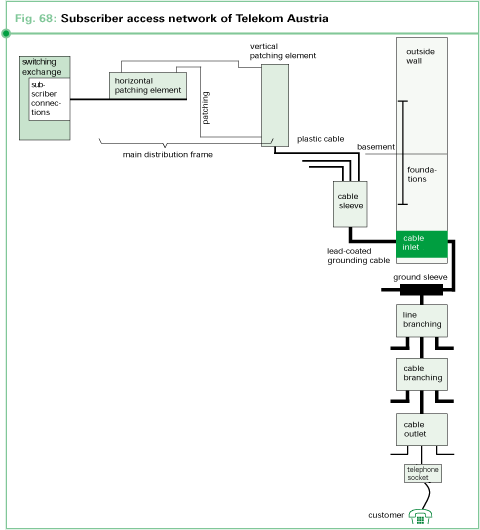
In the case of full unbundling, the full length of the copper wire pair from the subscriber to the switching exchange of Telekom Austria is given to the unbundling partner for his exclusive usage. In the case of sub-loop unbundling, this applies to sub-sections which, as a rule, extend from the subscriber to a certain point on the way to the switching exchange. In the case of Shared Use, Telekom Austria and the unbundling partner will share the frequency range on the copper wire pair of the subscriber connecting lines that has been technically prepared for use. Here, the unbundling partner gets the higher frequencies, Telekom Austria gets the lower frequencies, which are already used now for voice telephony transmission. The following comments relate to the full or sub-loop unbundling, on which the unbundling proceedings that were conducted during the period under review focused. For a better understanding of the underlying technical processes, the line infrastructure in the subscriber connection area in the network of Telekom Austria is briefly decribed below. Although one speaks of a "subscriber connecting line" or the "copper wire pair", a closer look reveals that there is no continuous double-wire line from a switching exchange to the end user. Rather, the connecting section consists of several electrically linked sub-sections. The part called line-technology network (which, in turn, consists of sections) leads from the switching exchange to the distribution frame in the building, where the so-called cabling inside the building begins, which is the final section of the subscriber connecting line that leads to the telephone socket in the house or apartment of the end user. The line technology network starts out with thick cables (e.g. 1200 paired), in the area of the switching exchanges, which then become thinner lines in a step-by-step process on their way to the distribution cabinet inside a specific building. One distinguishes between a rigid network and the switching network. In the rigid network, the cables are divided and put into sleeves in the ground, which does not allow for any changes at a later date. In the switching network, however, the cables are branched inside the distribution cabinets. Both, the lines of the (underground) cable on the side of the exchange and on the side of subscriber, are made accessible at a distribution rail. Connections can easily be made and modified between the two distribution rails ("patching"). One speaks of line branching and cable branching points. From the latter, the cable extends to the distribution cabinet inside the building. In big office or residential buildings, there will be additional distribution cabinets on every floor, before the final line sections leads up to the subscriber's socket. Fig. 68 is an illustration of this. |
In the building of the switching exchange, the individual lines (wires) in the cables that come from the connecting system and from the subscribers are made accessible in one distribution rail each. The distribution elements are mounted both horizontally and vertically. From the horizontal side of the main distribution frame (HVt), cables with plastic insulation extend to the subscriber connections at the exchange system. From the vertical side of the main distribution frame cables with plastic insulation extend to the sleeves' room in the basement, where the connection is made to the underground cables. The patching of the individual subscriber connecting lines (TASL) is always between the vertical and the horizontal side of the HVt. Fig. 68 shows the possible connecting points all the way up to the end user, beginning at the point where the cable is led into the building of the switching exchange. In case of full unbundling, the unbundled TASL is led from the horizontal main distribution frame via a transfer cable to the transfer distribution frame. Here begins the responsibility of the unbundling partner. If the transfer distribution frame is in the building of Telekom Austria, this step is called collocation. If there is not enough room in the building, containers may be used that are set up on the premises of Telekom Austria (Outdoor Container) or in the immediate vicinity (Street Cabinet). One ultimate possibility is the so-called "passive extension", for example up to apartments or basement compartments in the immediate vicinity, which the unbundling partner rents. The implementation of sub-loop unbundling is much more complex, from a technical viewpoint. In the framework of the present report the many different possible problems cannot be described, which may occur due to the construction or the structure of the respective switching exchange in a specific case. A central question is how the transfer to the unbundled section of the TASL (local loop) can be implemented at the switching point (line branching point, cable branching point, distribution cabinet in a building, distribution cabinet on a building floor) that the unbundling partner wishes to have, without affecting the remaining infrastructure of the Telekom Austria line. It may be said in general, though, that indoor sub-loop unbundling (i.e. the switching point in question is inside a building) is less complex, as a rule, than outdoor unbundling. Reference is made to an outdoor cable branching point by way of example, where - as a rule - a mechanical access (borehole) must first be provided for the patching cable or the cable of the unbundling partner, which should then be closed again as a connection and should be tight against humidity. Moreover, such distribution frames in the public sector will not always be in places where another distribution cabinet for the unbundling partner may be set up without problems. Another area of complex problems relates to the area of lightning and overvoltage protection, where existing protective measures must not be affected by unbundling. Practical experience to date shows that the sub-loop unbundling variant is of little practical significance (at present). |
 |
||