|
6.5.4 Frequency spectrum UMTS/IMT-2000 UMTS (Universal Mobile Telecommunications System 2000) is the European contribution to IMT, the worldwide mobile communication system of the third generation. Mobile radio communication systems of the first generation are analog systems, such as the D network in Austria. GSM (Global System for Mobile Communications) is the most successful representative for mobile communications systems of the second generation. With more than 200 million subscribers, GSM (standardised in Europe) has spread far beyond Europe. UMTS/IMT-2000 is to be implemented as of 2002. It will combine the functionalities of mobile radio communication systems, cordless systems and paging systems. With UMTS it will be possible to offer data rates that go far beyond those of current mobile systems. As a result, mobile multi-media applications (integration of speech, image and data communication) will be implemented. UMTS/IMT-2000 consists of a terrestrial system and a satellite system.
The satellite system will facilitate mobile communication especially in
those places where a terrestrial coverage is not available. The activities
on the European and national levels currently focus mainly on the terrestrial
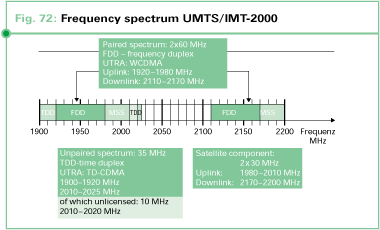
component. Moreover, the terrestrial component of UMTS is being discussed. For Europe the frequency bands for UMTS/IMT-2000 are defined in the decisions ERC/DEC/(97)07 and ERC/DEC(99)25. For the terrestrial part of UMTS/IMT-2000 a total of 155 MHz have been set aside. Of these, the ranges 1920 to 1980 MHz as wells as 2210 to 2170 MHz, i.e. 2 x 60 MHz, can be used as paired frequency bands, and the areas 1900 to 1920 MHz as well as 2010 to 2020 MHz are reserved for "non-licenced" applications. The range 2010 to 2020 MHz is therefore not available for assignment to operators in states that are transposing the relevant ERC decision. This means that 145 MHz (2 x 60 MHz + 25 MHz) can be assigned to operators. |
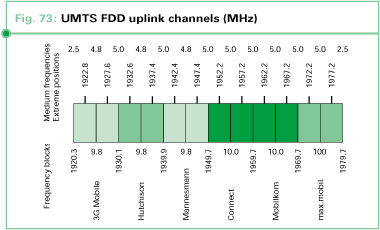
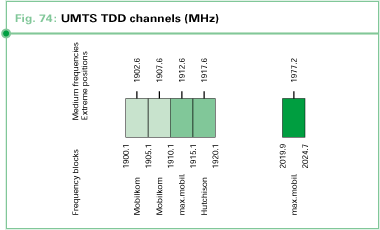
The entire frequency spectrum will not be used in all European countries for UMTS/IMT-2000, as different other applications, such as radio relay and military applications, operate in this frequency band. In Austria, the entire spectrum of 155 MHz is reserved for UMTS/IMT-2000. The UMTS Forum - where operators, manufacturers, regulatory authorities and other organisations are members - estimates that additional frequency bands (extension bands) will be required for UMTS after 2005. IMT-2000 (International Mobile Telecommunications) is the worldwide mobile communication system of the third generation. ITU (International Telecommunications Union) is responsible for standardising IMT 2000. IMT 2000 will combine different mobile communication systems of the third generation in the framework of a family design. "Roaming" will, however, be possible between the different systems. UMTS, the European contribution to IMT 2000, is standardised by ETSI (European Telecommunications Standards Institute), together with other standardising institutes in the framework of 3GPP (3rd Generation Partnership Project) . In January 1998, ETSI took a decision regarding the radio interfaces for UMTS. The radio interface UTRA (UMTS Terrestrial Radio Access) comprises W-CDMA (Wideband Code Division Multiple Access) for operation in the FDD mode (Frequency Division Duplex) and TD-CDMA (Time Division Code Division Multiple Access) for operation in the TDD mode (Time Division Duplex). The data rates of UMTS are said to be 144 kbit/s, as a minimum, in rural areas, and 384 kbit/s in urban areas, and 2048 kbit/s in areas with high capacity requirements (for example within buildings). For both access methods (W-CDMA and TD-CDMA) the bandwidth taken up by a channel is 5 MHz or slightly less. Especially in the case of neighbouring frequency channels, which are used by the same operator, a lower distance between carriers than 5 MHz may be used. The situation in Austria, following the auction in November 2000, is shown in Figs. 73 and 74 32.
|
|
||||||
 |
||||||