III.2.2.2 Interconnection
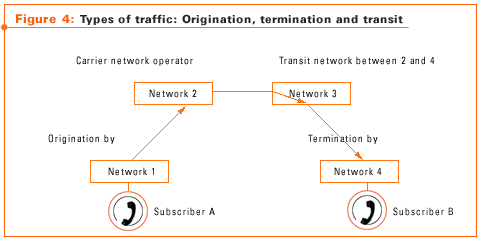
According to the definition given in section III.2.2, interconnection services are considered to be, in particular, the establishment of the physical network connection as well as termination, origination and transit of calls. In the following examples these types of traffic shall be demonstrated: a customer (subscriber A) connected to network 1 calls a customer (subscriber B) of network 4 via a carrier network (10xx of network 2).
In this case
- network 1 provides the origination service (up to network 2),
- network 3 provides the transit service, since in this example networks 2 and 4 are not directly interconnected and
- network 4 provides the termination service up to subscriber B.
| Info Box 14: Definition of "Termination", "Origination" and "Transit" | ||||||
|
The carrier network (network 2) bills the end-user and shall compensate the other operators for the interconnection services.
|
III.2.2.2.1 The legal framework for interconnection
The European regulatory framework imposes on operators with significant market power an extensive obligation for interconnection, whose concrete final formulation is left to the legislator of the Member State. The Interconnection Directive (directive 97/33/EC as amended by 98/61/EG), in particular, emphasises that fair, proportionate and non-discriminatory conditions for interconnection and interoperability are "key factors in fostering the development of open and competitive markets". Interconnection does not least ensure that, due to the availability of all subscribers of all networks, positive network externalities can be utilised. Apart from the regulatory complex of sector-specific Directives, of course, also the general rules on competition of European law (i.e. in particular Art. 81, 82 and 85 EC Treaty) are applicable to network access and interconnection issues.
The physical and logical linking of the networks required under European law is ensured in TKG by special provisions for network access in the form of interconnection. The basic provision with regard to network access is contained in Art. 37. Accordingly, an operator of a telecommunications network who offers public telecommunications services and has significant market power shall make it possible for other users to access his telecommunications network or unbundled parts thereof. Pursuant to Art. 37 (2) TKG, network access shall be granted via connections that are in general demand on the market ("general network access"). However, network access can be also granted via special connections ("special network access"). Whereas Art. 37 (1) TKG imposes on the operator with significant market power the obligation to grant access to his network or unbundled parts thereof, Art. 41 (1) TKG imposes on all operators of public telecommunications networks (not only on those with significant market power) the obligation to make an interconnection offer to other operators of such networks.
If the operators do not reach an agreement within the minimum negotiation period of six weeks required by law, each may bring the case before TKK (Art. 111 TKG). It is a prerequisite for such recourse that within a period of six weeks as of receipt of the request (for network access) no agreement on interconnection (either in total or only in some points) has been reached. Then, TKK shall decide on the interconnection within a period of six weeks (which may be extended to ten weeks). This decision will supersede the agreement under private law.
The framework under substantive law which TKK has to take into account in its decisions is based on:
- the provisions of TKG, in particular Art. 3 Z 16 and Art. 37 - 41 TKG,
- the provisions of the secondary legislation on interconnection (Interconnection Ordinance (ZVO)
- as well as the valid provisions under European law, first and foremost the Interconnection Directive (97/33/EC as amended by 98/61/EG) already mentioned.
The scope of interconnection is defined in Art. 38 TKG as well as in Art. 3 Z 7 and 16 TKG (see also Info Box 11). With interconnection the functional component is of paramount importance, aiming at ensuring a functioning end-to-end communication between the users of different networks. Art. 38 TKG further defines the scope of interconnection which shall comprise at least the following services:
- ensuring access by users of an SMP operator to the network of a new provider by means of carrier pre-selection or on a call-by-call basis according to the numbering plan;
- provision of the necessary traffic data of the respective connection to the interconnected provider;
- delivery of calls to users of the respective other interconnected operators;
- provision of the data required for billing to the interconnected provider in suitable form.
The interconnection charges applying in connection with these services as well as the charges for access to the unbundled local loop shall be determined according to the principle of cost orientation on the basis of the costs of an efficient network operator (Forward Looking Long Run Average Incremental Costs - FL-LRAIC), as required by law (Art. 41 (3) TKG and Art. 8f ZVO).
| Inf Box 15: Definition
of "Forward Looking Long
Run Average Incremental Costs - FL-LRAIC" |
|
According to the FL-LRAIC approach, a new provider shall pay only for the services directly attributable to interconnection in addition to the costs for the provision of efficient service rather than the fully distributed costs based on historic purchase prices of the SMP operator. |
Since this approach is of particular importance, it will
be explained in greater detail in a separate chapter (see section
III.2.2.2.2)
To prevent abuse of market power in the field of interconnection conditions
the following obligations for organisations with significant market power
are provided in the relevant legal standards:
- Non-discrimination
An organisation having significant market power shall not discriminate between organisations active in the market. The services provided by an organisation with significant market power to itself, an affiliated company or another organisation operating on the market shall be also provided to other organisations operating on the market under the same conditions and of the same quality. This shall apply in particular to internal transfer prices between affiliated companies. - Unbundling
Companies shall not be forced to have to buy other services they do not need together with those needed. Therefore, the services and products shall be provided also in unbundled form. - Mandatory collocation
In implementing physical interconnection it is necessary to connect the infrastructure of the new market entrants with that of the established operator. It is considered an essential market barrier if the new providers cannot bring their infrastructures sufficiently close to that of the SMP operator. Therefore, the SMP operator is obliged to enable the new entrants to install their infrastructure on his premises by providing for collocation space. - Quality of service
In order to guarantee undisturbed and high-quality operation of the networks quality standards are required whose compliance will be checked. This obligation is imposed on all network operators. - Uniform standards
To interconnect different telecommunications networks it is necessary to specify uniform technical standards. These national and international standards ensure interoperability between the networks. - Publication of a Reference Interconnection
Offer (RIO)
To be able to check compliance with non-discrimination it is necessary to inform the market players of the interconnection conditions. This shall be achieved by the publication of a Reference Interconnection Offer. TKC publishes the Reference Interconnection Offer of the companies with significant market power on its web site http://www.tkc.at/. The interconnection offers of the other operators are available at TKC for inspection. - Minimum number of points of interconnection
The points of interconnection (POI) are the points in the network (interfaces) at which the telecommunications network are interconnected. The entire traffic between the networks is carried via these points. Location and number of points of interconnection have great influence on traffic routing in the interconnected networks and thus on the cost arising for the network operators. - Cost oriented interconnection charges
To prevent costs not due to interconnection from being attributed to interconnection services, the European Commission prepared recommendations stating principles on the calculation of interconnection charges. For example, these charges shall not contain shares in the costs caused by the access network..
Especially since the field of interconnection charges is of particular importance for the development of competition in telecommunications, the European Commission has been conducting benchmark studies on the amounts of the charges on a regular basis since 1997. The results of the studies are published by the EU Commission (see Fig. 34).


