1.2.1.3 Overall welfare
Another subject to be examined is the development of overall welfare, as defined in the (economic) welfare theory. Liberalisation of previously monopolistic economic branches leads to an increase in overall economic welfare, which, certainly, is a strong motive for the European-wide – and, in fact, worldwide - liberalisation of the telecommunications sector. The transition from a monopoly to a competitive situation is accompanied by several effects. Basically, it must be stated that overall welfare (defined as the total1 of consumer’s and producer’s surplus) of the national economy will increase in the course of this process.
The total of the consumer’s and producer’s surplus will increase, while, at the same time, distribution will shift in favour of the consumer’s surplus. Moreover, the pressure imposed by competition will give rise to the fact that all companies on the market, also the former monopolist, will have to make major efforts to increase their efficiency. Thereby, the costs will decline, the cost functions will shift downwards and the services will be provided more efficiently.
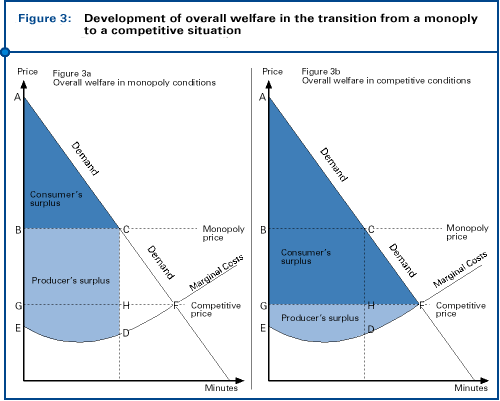
Figure 3 shows graphically how overall welfare will change in the transition from a monopoly to a competitive situation. In a monopoly situation, the consumer’s surplus is the area of the triangle ABC, the producer’s surplus is the area BCDE. In the transition to full competition the consumer’s surplus will increase to the area AFG and the producer’s surplus will decline by the area of the rectangle BCHG to the area EDHG, where a partial compensation will be achieved by an additional producer’s surplus in the amount of the area DFH.
The available data allows a careful estimation of the change in consumer’s surplus and the change in producer’s surplus, although the compensatory increase in the producer’s surplus cannot be calculated reliably, as no reliable data on production costs in the telecommunications sector is known. Here, cost estimates have to be used. The results of the calculations shall not be classified as scientifically correct but shall give an idea of the most important dimensions. To give an initial impression of the dimensions, first the key data shall be briefly presented:
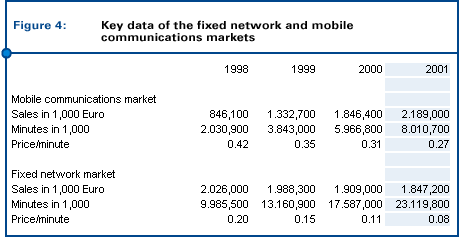
Once again, the dynamic development of the telecommunications sector in the past few years can be seen. In the fixed network, since 1998, the number of traffic minutes per year increased by a total of 130%, with sales decreasing slightly. The prices per minute fell by approx. 60% during this period. The rapid development of the mobile communications market in Austria speaks for itself as clearly.
This data can be used to approximately calculate the welfare effects, or more precisely, their changes. Between 1999 and 2001, in the fixed network, there was an increase in the consumer’s surplus of approx. € 3.94 billion2 , which was accompanied by a decrease in the producer’s surplus of approx. € 1.57 billion. In simple terms, the end-users, i.e. the Austrian economy and the Austrian consumers, saved approx. € 3.94 billion since liberalisation of the fixed network started, while the volume of voice telephony increased to the 2.3 fold and the prices fell by 60%.
For the telecom providers, mainly Telekom Austria, liberalisation caused a total decrease in the historical producer’s surplus by approx. € 1.57 billion from 1998 to 2001.
As, at the beginning of liberalisation of the fixed network, the mobile communications market had already two operators, Mobilkom and T-Mobile, and Connect, the third provider, was in the process of rolling out its network, the effects in the mobile network were clearly smaller. The estimates for the accumulated welfare gains were about € 940 million for the whole period. The decline in producer’s surplus was about € 340 million, the increase in consumer’s surplus was € 1.28 million. Ceteris paribus, an annual welfare gain of approx. € 500 million can be expected in the future.

