III.2.2.3 Unbundling
In the decision of 02.07.1999 (Z 1, 3 and 4/99), TKK laid down the conditions for unbundled access to the local loop. This means that alternative network operators do not only depend on installing their own infrastructure in order to connect to end-users directly but that they can make use of Telekom Austria's copper access network.
| Info Box 17 : Definition of "Local loop" |
|
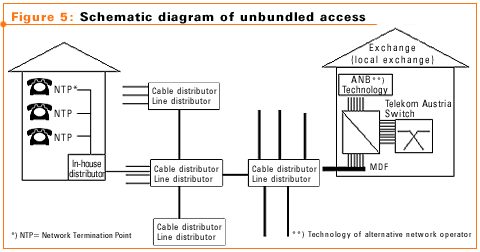
The local loop is the physical/electrical connection between the end-user and the telecommunications networks operator's local exchange. This line, usually a copper pair, connects the network termination point (NTP) at the user's premises with the main distribution frame (MDF) of the network operator. |
Unbundled access to the local loop means that the copper pair at the main distribution frame (MDF) is no longer conducted to the Telekom Austria switch but passed on directly to the alternative network operator by means of electrical through-connection.
Via one local loop different services can be provided, which can be either conventional voice telephony (POTS), ISDN services or high bit rate services like fast Internet access via xDSL. Even though the same copper pair is used and the same costs arise for the copper pair as physical medium, the end-user tariff and the revenues to be generated from the various services differ greatly.
 |
Network operators are anxious to maximise their profits or contribution margins. Since obviously there is no or only little competition in the field of high bit rate services, the potentials for profit are particularly high. The end-user can be connected either via the operator's own infrastructure or other already existing infrastructure. Although it is basically desirable for an alternative network operator to have his own access network (higher flexibility and autonomy) complete re-cabling of Austria would be very expensive and economically questionable. Direct connection of (highly profitable) business customers via their own access network not yet existing may often be practical in individual cases or for strategic reasons. However, the large remainder of end-users already connected to the incumbent can choose from two options
- on the one hand, connection of the end-user can be implemented via a dedicated line which is leased from the incumbent and connects the end-user with the technical facilities of the alternative network operator; this is also quite expensive.
- the second option is to lease the existing local loop from the incumbent and provide telecommunications services via self-connected transmission equipment.
Unbundled access to the local loop does not only offer a potential for price differentiation (as in carrier network operation) but also creates the prerequisites for the emergence of new service markets and an even further differentiation of the product range against that of the operator with significant market power. By this, alternative operators are given the opportunity to flexibly design innovative offers, custom-built for individual user groups.
From the perspective of promoting high-level location quality and supplying the population with high-quality and innovative services, high bit rate usage options of the local loop are to be welcomed. Effects of unbundling on competition, also allowing for high bit rate services, are not only expected to occur on the leased line market but likely to appear with all alternative network operators who, in parallel to the local loop, already have direct access to the customer (e.g. cable TV operators offering two-way communication). Unbundling with the sole purpose of providing narrowband voice telephony service seems to generate little profit, as can be seen in Germany. The chief effect on competition can therefore be expected to occur in the fields of new (high bit rate) services and (local) leased lines.


