6.2.5.2 Public mobile radio communications systems
In addition to public trunked radio communications networks (PAMR, Public Access Mobile Radio, the European ETSI standard in the digital area is TETRA), which are used by companies or authorities, during the period under review the following public mobile radio communications networks were operative, or in preparation, in Austria:
- four GSM networks (the networks of Mobilkom, T-Mobile, Connect and tele.ring) with digital voice transmission at the air interface);
- one mobile radio communications network (the D network of Mobilkom) with analogue speech transmission at the radio interface; this analogue network was closed down at the end of February 2002;
- six UMTS networks (the networks of Mobilkom, T-Mobile, Connect, Mannesmann, 3G Mobile and Hutchison) [in preparation].
Each of the operative networks has its own infrastructure, which covers the entire Austrian federal territory. Call connections within one network can therefore be implemented without having to resort to the services of other networks. In order to facilitate call connections to other networks, several switching exchanges to other fixed and/or mobile radio communications networks are interconnected directly or indirectly.
The infrastructure of a mobile radio communications system consist essentially of the following components:
Access network:
- base stations (BTS - Base Transceiver Station)
- base station controllers (control units for groups of base stations)
- connections between these network components
- mobile switching centres (switching exchanges)
- connections between these network components
A typical mobile network operator operates both an access network (i.e. he uses radio frequencies) and a core network. Alternatively, a Mobile Virtual Network Operator (MVNO) only operates a core network, while the access network is provided by another network operator. Outgoing and incoming calls of a customer with a SIM card of the MVNO are always carried over the switching centres of the MVNO.
The connections between the aforementioned network components in the access or the core networks are implemented with the operator's own lines, leased lines or by means of radio relay.
In GSM as well as in the first two releases of UMTS (release 99 and release 4) voice will be transmitted by means of circuit-switching, release 5 will introduce Voice over IP (VoIP), using the Session Initialization Protocol (SIP).
The base stations consist of antennas that are mounted on masts or building roofs, and switching cabinets that contain the necessary technical transmission equipment. The connection to the mobile units is set up by means of radio transmission via the base stations. A base station has a range between approx. 100 metres and several tens of kilometres. In order to secure full coverage in Austria, one operator needs 2,000 to 3,000 base stations. In areas where an operator must handle a very big volume of traffic, i.e. in regions where there are many telephone calls, further base stations must be built, in addition to those basically required for coverage. These are often so-called micro cells, using very small antennas, which are mounted on buildings, only a few metres above the street level. Micro cells cover an area with a diameter of several hundred metres and are used in densely populated urban areas.
Several dozens of base stations each are linked to a base station controller, which is responsible for the logical control of these base stations. These connections are implemented by leased lines and via radio relay.
Several base station controllers, in turn, are connected and linked to the exchanges. Every GSM operator has about ten to 20 mobile switching centres (MSC). Databases (Home Location Registers, HLR) available in every mobile network know the approximate whereabouts of every subscriber. Incoming calls are signalled in the area where the subscriber is located ("location area").
A distinction is made between the Home Location Register (HLR), where the data on the whereabouts of the subscriber assigned to the MSC in question is stored, and the Visitor Location Register (VLR), where data for subscribers from other MSCs is stored. Whenever the "visitors" are subscribers of another network, they are called roaming subscribers (Roaming).
In Austria, at present roaming is only possible between networks in different countries. After the introduction of UMTS, it will be also possible to roam between UMTS and GSM networks (national roaming).
For public mobile radio communications systems - such as digital GSM - separate frequency ranges are laid down in the frequency usage plans. Parts of this frequency range will be allocated to mobile radio communications operators, who therefore have different frequency ranges at their exclusive disposal. The frequency ranges used for GSM are 900 MHz (GSM-900) or 1800 MHz (GSM-1800 - previously called DCS 1800). In addition to voice telephony, which forms the larger part by far of the generated traffic, operators offer circuit-switched data services at transmission rates of up to 9.6 kbit/s. The modern variant HSCSD (High Speed Circuit Switched Data which is offered in Austria by one operator) achieves up to 57.6 kbit/s with four trunked time slots.
The circuit-switched data services are increasingly being replaced by packet-switched data services (General Packet Radio Service, GPRS).
With GPRS, the radio channel is seized only when data is actively transmitted. Thus, the limited radio frequencies are used more efficiently. Billing can be carried out on the basis of the amount of data transmitted – regardless of the online time.
GPRS will also form the basis for the data transmission of UMTS, but at a significantly higher transmission rate (approx. 384 kbit/s) and shorter delay than with GSM. The rate of 2 Mbit/s that is often stated for UMTS, in practice, will not be found very often in the first generation.
In addition to GSM, which is widely distributed worldwide, several countries still operate mobile radio communications networks with analogue voice telephony at the air interface, such as the D network in Austria (900 MHz frequency range), which was closed down at the end of February 2002. These networks can be regarded as forerunners of GSM. They offered limited functionalities. For example, data transmission and short-message services (SMS) are available only within certain limits.
Satellite systems, such as INMARSAT, are also used for mobile communications. INMARSAT uses geo-stationary satellites at an altitude of about 36,000 km and facilitates communication to almost every place on earth. The radio connection is between the mobile unit, which is much bigger than a conventional GSM unit, and a satellite. The capacity, i. e. the number of subscribers per square kilometre that can be serviced, is much lower with satellite systems than with GSM. Low-orbit systems (LEO, MEO systems) are under development or have not been able to gain market acceptance (e.g. IRIDIUM, Globalstar).
Paging systems only make it possible to send a message to a subscriber. They are increasingly being replaced by GSM.
In addition to the aforementioned systems, which all may also be used by private as well as business customers, there are systems that are specifically adapted to the communications needs of companies and undertakings. These so-called trunked radio systems work similarly to GSM, but permit more comprehensive group communication and a very fast call set-up. The users of such systems will be, for example, the police, the fire brigade, ambulance services, construction businesses or taxi companies. The standard defined by ETSI for digital trunked radio systems is TETRA. TETRA uses frequency channels with a bandwidth of 25 kHz. So far, the individual organisations have built up their own trunked radio networks. In Austria, frequencies in the 400 MHz range are used for TETRA.
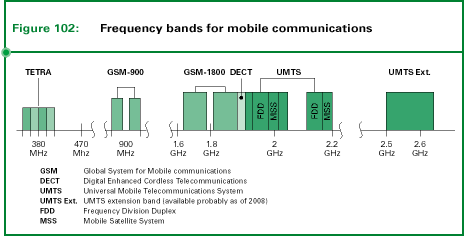
Fig. 102 gives an overview of the
frequency bands for GSM-900, GSM-1800, DECT and UMTS: