
The AI Act provides for a graduated framework for the temporal scope of the provisions. The different dates take into account the risk potential of certain practices and the necessary adaptation effort. The timeline was adapted as a result of the Digital Omnibus on AI.
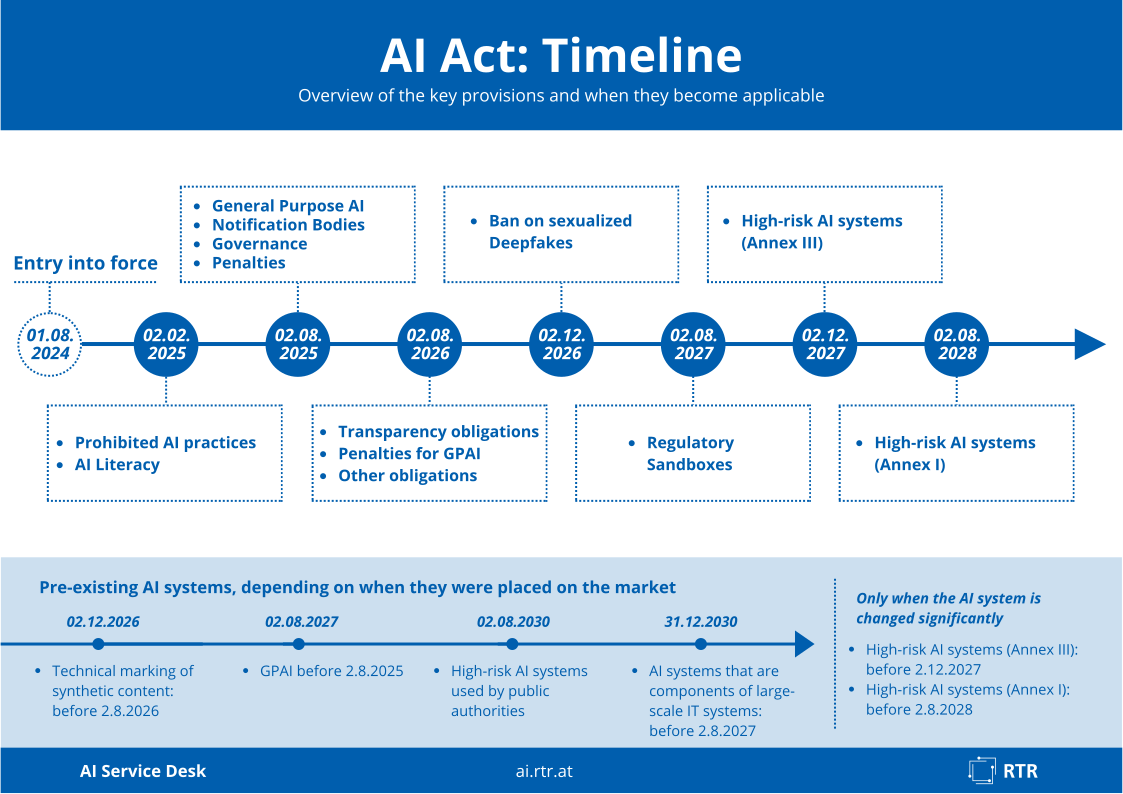
Entry into force of the AI Act
1.8.2024 (20th day following publication in the Official Journal of the European Union)
2 February 2025
As of 2 February 2025 the practices classified as "prohibited" may no longer be used. The regulations on AI competence ("literacy") also apply. This means that providers and operators of AI systems are obliged to take measures to ensure that their staff and other persons involved in the operation and use of AI systems on their behalf have sufficient knowledge.
Further information on prohibited AI practices pursuant to Article 5 of the AIA is available here: Risk levels of AI systems
Further information on AI literacy is available here: AI Literacy
2 August 2025
The provisions on general purpose AI are mandatory as of 2 August 2025
Further information are available here: Risk levels of AI models
Furthermore, the regulations on notification bodies also apply. Member States are obliged to designate at least one notifying authority that is responsible for setting up and carrying out the necessary procedures for the assessment, designation and notification of conformity assessment bodies and for their monitoring.
The governance provisions also apply, requiring the Commission at Union level and the Member States at national level to set up or designate the authorities and institutions provided for.
In addition, the penalty provisions apply from this date, with the exception of penalty provisions on GPAI providers, which apply 24 months after the AI Act comes into force.
2 August 2026
The transparency obligations in Art 50 AIA come into force on 2 August 2026. Also, the provisions on the right to lodge a complaint pursuant to Art. 85 AIA as well as the right to an explanation of individual decision-making pursuant to Art. 86 AIA apply.
Monetary penalties applicable to general-purpose AI (GPAI) models also enter into force.
Further Information to transparency obligations are available here: Transparency obligations
2 December 2026
As of 2 December 2026, the use of sexualized deepfakes without the consent of the person depicted is prohibited (this extends the catalogue of prohibited practices in Article 5 under the AI Act Omnibus).
2 August 2027
As of 2 August 2027, AI regulatory sandboxes must be operational.
2 December 2027
As of 2 December 2027, the requirements for high‑risk AI systems set out in Annex III shall apply.
Further information on high-risk AI systems can be found here: Risk levels of AI systems
2 August 2028
As of 2 December 2027, the requirements for high‑risk AI systems set out in Annex I shall apply.
Further information on high-risk AI systems can be found here: Risk levels of AI systems
Deviating provisions for AI systems already on the market or in operation
- High‑risk AI systems referred to in Annex I that are placed on the market before 2 August 2028, and those referred to in Annex III that are placed on the market before 2 December 2027, shall only have to be brought into conformity with the AI Act in the event of substantial modifications to the AI system.
- High-risk AI systems intended for public authorities must be brought into compliance with the AI Act within 6 years of the effective date of the AI Act (as of 2.8.2030).
- AI systems for generating synthetic content placed on the market before 2 August 2026 have to be compliant with the transparency obligations of Art 50 para 2 AI Act by 2 December 2026
- GPAI models placed on the market before 2 August 2025 must be brought into compliance with the AI Act within 3 years of the effective date of the AI Act (as of 2.8.2027).
- AI systems that are part of large-scale IT systems in the area of freedom, security and justice (Schengen Information Systems [SIS], visa information systems, Eurodac, etc.) before 2 August 2027 must be brought into compliance with the AI Act by 31 December 2030.
Further deadlines
- Codes of practice for operators initiated by the AI Office are to be published at least 3 months before the relevant provisions come into force. This results in the following dates for the respective risk categories:
- 9 months after the AI Act comes into force (as of 2.5.2025) for GPAI models (mandatory);
- 21 months after the entry into force of the AI Act (as of 2.5.2026) for high-risk AI systems (Annex III) and AI systems with low and minimal risk (optional);
- 33 months after the entry into force of the AI Act (as of 2.5.2027) for high-risk AI systems (Annex III) and AI systems with low and minimal risk (optional).
- Guidelines for the practical implementation of high-risk AI systems (Annex I) are to be published 18 months after the date of entry into force of the AI Act (as of 2.11.2025).